
Remarketing with Email and Web Analytics
I have seen some articles that mention some great findings and research from eMarketing and pitches from Email marketing solutions integrating with web analytics solutions to improve conversions by remarketing with email. What can we do from a web analytics perspective before jumping on to implementing remarketing with emails?
In this writing, I would like to focus on remarketing with email. Keep in mind that to remarket via email, people have to have registered on your site or opted into your email program.
The best starting point is to review the site you are running the remarketing program. For example, your site could be e-commerce, content, lead generation, etc. It will help if you care because you need to understand the triggers that will send the emails and at what stage of the marketing funnel.
Second point, what interactions by these identifiable visitors would you consider abandonment? Abandonment, in this case, could be anything that you think people who didn’t execute the desired action, after subscribing or registering for communication.
Abandonment, in this case, could be anything that you consider people who didn’t execute the desired action after subscribing or registering for communication.
Examples based on the assumption that the site visitors are logged into the site and registered for email communication:
- People who added items to a shopping cart but did not complete checkout.
- I visited a specific page (like a promotional page) but didn’t complete the desired action like subscribing/registering/applying for a promo.
- Did not sign up for a magazine subscription.
- Didn’t bounce. Saw the old product but missed viewing the new product pages.
- Registered users with a Twitter account (based on profile info) but didn’t click or attempt to show interest in following the site owner or company’s Twitter account.
- If you have specific profile information about your email, then you can segment your email to go out to a particular profile. Like if a large enterprise lead is revisiting the site multiple times.
You get the idea. Remarketing could yield positive results. According to research found from various research and case studies. Research from prior ExactTarget found that transactional emails sent after a shopper abandoned items in a shopping cart improved overall company revenue by 30%. Therefore, remarketing could be an effective marketing tactic based on people’s interaction with the site.
A lot of the findings based on research talk about X% improvements in revenue or increase in conversion by Z% after doing XYZ. That makes me wonder about the kinds of web analytics data you should review before investing your time in executing a remarketing program.
Here are some ideas that I think web analytics metrics can help you decide rather tackle remarketing with email or not. The idea is to understand where your site stands in terms of data and better understand expectations from remarketing.
Email Registered users:
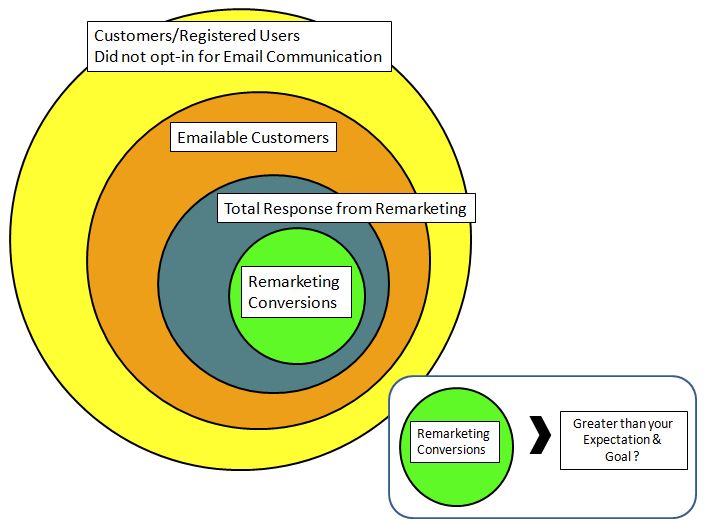
Your site may be selling your products pretty well. Still, if many shoppers didn’t opt-in to your newsletter (for whatever reason), then the overall volume of re-marketable people may not be significant.
Imagine an e-commerce site where the owner decided to give a customer an option to email communication at the thank you page, which caused only 1% of the overall customers to register.
Let’s assume there were 10,000 absolute customers to date. That means there are only 100 remarket-able customers. Is that a good number for you to invest in remarketing? You decide.
Email click-through rate (unique):
If your average click-through rate (unique clicks per email delivery) were around 1%, email would generate only one response from 100 emails you sent out.
If your site is awesome and has 1,000,000 absolute customers, with 1% of them registered for email, there will be 10,000 remarket-able customers. With a 1% click-through rate, you have about 100 responders to your remarketed email.
Conversion rate:
Self-explanatory, but let’s assume your remarketing tactics are so great (the best in the world), and 10% of the email responders complete the desired action. With the case with 1,000,000 absolute customers at 100 responders, you’ll get ten conversions.
Average order value (AOV) or Average Conversion Value (ACV):
Regardless of your site is e-commerce or not, it would be important to understand how much your conversion are valued. Say your site sells an item worth $100 on average, then that will be your average order value (or AOV).
With the 1,000,000 customers example, that will mean your remarketing efforts may generate about $1,000 in value. Not sure if that is good yet.
With the 1,000,000 customers example, that will mean your remarketing efforts may generate about $1,000 in value. Not sure if that is good yet.
Return on Advertising Spending (ROAS):
So you may be happy that $1,000 is a great outcome, and now you can buy your team some drinks… but wait. Ask yourself how much money you are planning or expected to go out of your pocket for this remarketing program?
Let’s say you paid this freelancer who used to work at a top marketing agency for about $1,500 (I’m sure it is more in reality). Using above scenario, your ROAS is 67% (1,000/1,500). You lost some money just running the remarketing program. Nice… maybe that’s why you hear a lot of fancy agencies having trouble making their clients happy because clients might be seeing this ROAS below 100%.
Additional/potential value-generating from remarketing outcome:
This is where your segmentation in web analytics tool comes into play. If your remarketing efforts drive certain results or interactions, what does your web analytics segmentation tell you about those visitors after they converted or show potential additional value?
Say you segmented those ten converted customers (visitors coming from remarketing email) and found out they advocate the site’s product through the tell-a-friend feature. You happen to know that tell-a-friend or advocacy by customers generates about $50 in value.
Therefore, ten customers telling 10 of their friends generated an additional $500, making your ROAS 100%. The idea is to look at different interactions and outcomes segments, so your remarketing efforts are based on interactions that drive the biggest return.
These interactions could exist even before running the remarketing program, so understand the values from different “micro conversions” using segmentations. Here is a nice article about “Macro and Micro conversions. “
The challenging part is to assign some $ value to those micro-conversions or those segmented interactions that lead to additional returns for your site/business.
A visual to support my writing…
Nowadays, these are common practices for many marketers using tools like Marketo, Eloqua, etc.
These tools integrate with CRM platforms like Salesforce and trigger email based on various status changes.
But I have learned that email is a lot more effective when you have combined profile data with behavior data and send out an email based on certain behavior you want to have your audience take.
Thank you so much for taking the time to read my content. If you've liked what I've had to say please subscribe!

ZoomMetrix Newsletter
Join the newsletter to receive the latest updates in your inbox.